
My Soul Recognised You غُرْبَة
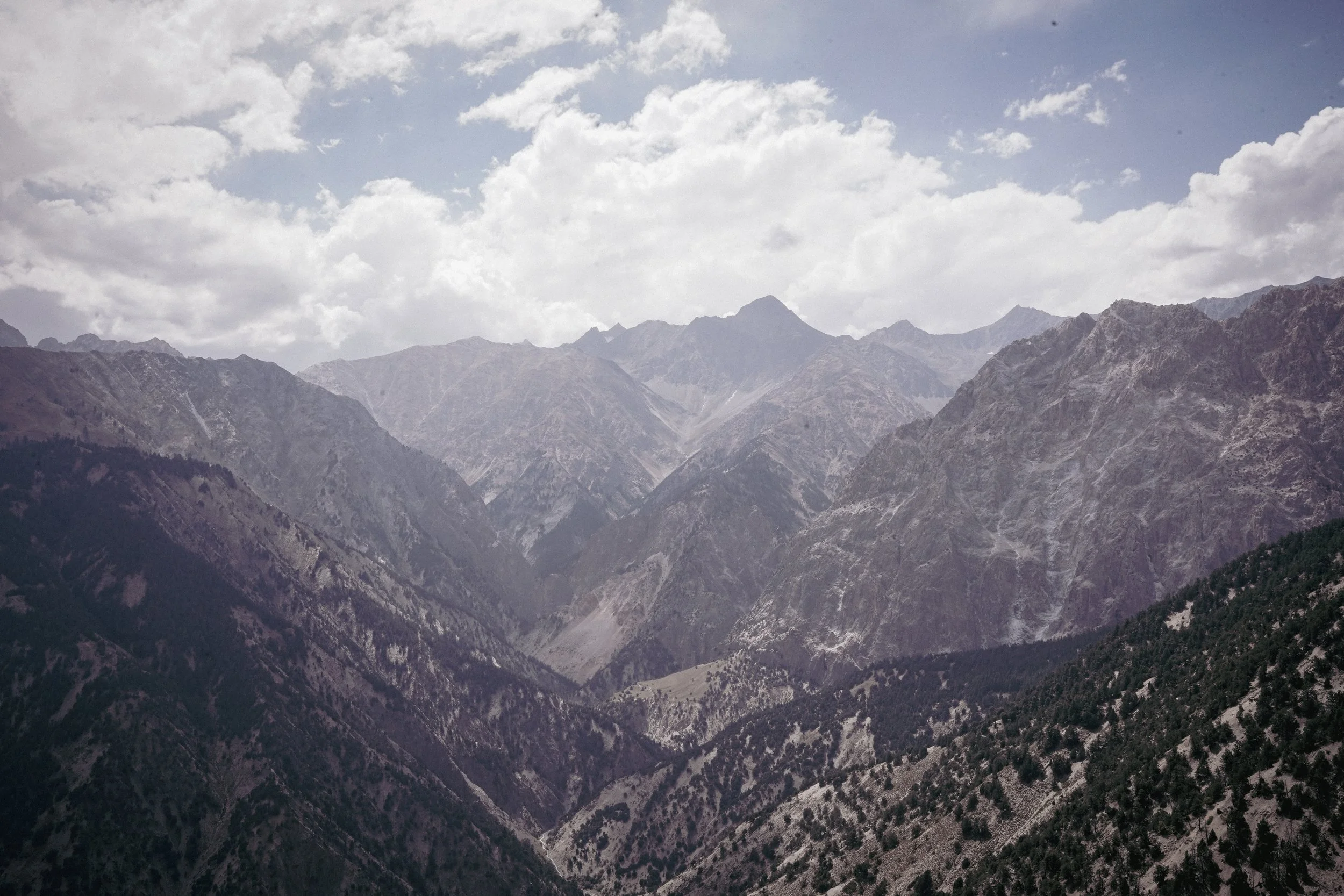
He writes to me on the day I am missing him most.
That morning I wake with the strange sensation that someone has been standing on my heart. There is no other way I know to describe it. Nothing has happened, and yet something has. The body sometimes receives news before the world delivers it. I lie still beneath the blankets in Chitral, listening to the faint movements of the house, and already my mind has gone towards him.
This happens when I am not occupied.
Work protects me. Fieldwork protects me. Wool protects me. The journeys through villages, the conversations with elders, the administrative debris of running an organisation, the endless practical matters of living in a mountain town—all of these create a temporary architecture around longing. But when the structure falls quiet, my heart begins its wandering.
And it almost always wanders towards him.
That morning the remembrance is unusually deep. Not memory exactly. Memory implies something completed, stored somewhere behind us. This is closer to dhikr: remembrance as an active condition, a returning. In Islamic practice, dhikr is the repetition through which the heart attempts to remain conscious of God. The tongue remembers until, perhaps, the body itself begins remembering.
There are people we remember in a similar way.
Not because we confuse them with the divine, but because certain encounters alter the instrument through which we perceive the world. Their absence develops its own pulse. You carry them not as an image but as a frequency.
I wanted him, somehow, to hear every syntax of what I was feeling: the visible sentences and the invisible ones, everything grammatical and everything that could never submit to grammar.
Then my phone lights.
The small green WhatsApp icon appears.
For a moment, I think my eyes have invented it.
His name.
There is something almost comic about the collision of technology and longing: centuries of poetry reduced to a notification. Once a lover waited for a rider to cross a mountain pass carrying a folded letter against his chest. A message might travel weeks between valleys, along caravan routes, across rivers and contested borders. Now a person can enter your bloodstream in less than a second.
Still, the heart has not modernised.
I stare at the screen.
There is that childish hesitation: should I open it?
I open it immediately.
And I smile.
***
I have often wondered what constitutes a relational space.
Anthropology gives us many languages for relation: kinship, reciprocity, affinity, exchange, obligation. We map how people belong to one another. We draw diagrams. We record genealogies. We ask who marries whom, who feeds whom, who inherits from whom, who remembers the dead.
But there are relationships that refuse the diagram.
What name do we give to the space created between two people who recognise each other before either fully understands what has been recognised?
What measurement can be applied to the silence between two sentences when the silence contains more information than either sentence?
Perhaps a relational space is not a place at all. Perhaps it is something produced by attention.
When someone looks at you long enough for your performance of yourself to become unnecessary.
When another person witnesses what you have spent years arranging into concealment.
When grief is not explained but allowed to sit between two people like a third presence.
I never cared very much where he came from.
And yet, perhaps, this is not entirely true.
He is Afghan. Nuristani.
Those words contain histories much larger than either of us.
Nuristan sits beyond the ridges west of Chitral, a place whose very name means the land of light. Before the late nineteenth century, much of it was called Kafiristan by outsiders, referring to communities whose pre-Islamic ritual worlds had survived in the high valleys of the Hindu Kush. After the Afghan ruler Abdur Rahman Khan conquered the region in the 1890s and imposed Islam, it was renamed Nuristan: the land of nur.
Light.
History rarely allows such beautiful words to remain innocent.
Names are often placed over landscapes like new cloth over an old wound. Beneath them remain other languages, gods, songs, migrations, forced conversions, marriages, disappearances. Mountain regions remember these layers differently from states. A border can be drawn in ink in Kabul, Islamabad, London or Delhi, but a shepherd’s path will continue crossing it.
Perhaps this is why his being Nuristani does mean something to me.
Not because I want to turn him into an artifact of his geography. I resist that temptation fiercely. Anthropology has often done terrible things to people by making them stand in for cultures, by turning a human being into evidence.
He is not evidence.
He is himself.
But we carry landscapes inside us.
Sometimes unconsciously.
There was something ancient in the way he inhabited silence.
Something watchful.
Something that made me think of mountain passes.
And there was light.
I do not mean beauty, although he was beautiful to me. I mean something closer to nur—that difficult Islamic idea of illumination, the light through which things become perceptible.
The Qur'an speaks of God as the Light of the heavens and the earth, and gives us the image of a niche containing a lamp, the lamp inside glass, the glass shining like a radiant star. I have always been moved by the architecture of that verse: light contained within light, vessel within vessel, luminosity protected yet multiplying.
When he entered my life, something became visible.
Not him alone.
Myself.
***
We had both needed to be seen.
That is perhaps the most dangerous sentence in this essay.
There are encounters that arrive when the self is already fractured. Another person cannot repair you, and perhaps should never be asked to. But they may sit beside the fracture. They may run a finger along its edges without recoiling.
He needed healing.
So did I.
When I listened to him speak about his dreams, his griefs, his jokes, the small humiliations of ordinary life, I felt something inside me loosening.
He was very funny.
This matters.
We speak too solemnly about those we love after they have become distant. We turn them into elegies before they have died. But love is also ridiculous. It is laughing until the body folds. It is an argument over nothing. It is a badly timed joke. It is recognising the precise expression someone makes before they begin lying about being fine.
There were moments when I looked into his eyes and felt that peculiar terror of being understood.
He carried broken things.
I carried broken things.
Neither of us asked the other to arrive whole.
Perhaps intimacy begins there.
Not in perfection, but in the agreement that fragmentation will not disqualify us from tenderness.
I embraced his broken parts as he embraced mine.
There was no heroism in this. No salvation.
Only recognition.
***
There was also something resilient in him.
I dislike the word resilience sometimes. Institutions love it. Development organisations love it. Communities experiencing generations of poverty, conflict, displacement and abandonment are constantly described as resilient, as though resilience were a natural resource they ought to continue producing indefinitely.
A mountain survives the avalanche and we praise the mountain.
We rarely ask who loosened the snow.
His resilience was different.
It was private.
An ancient instinct to remain alive without announcing the effort.
He challenged me constantly, though rarely through words.
It happened in what I have come to think of as the silence of the in-between.
There are forms of knowledge that emerge only there.
In textile making, the spaces between threads are not empty. A cloth exists because of those intervals. Warp and weft require distance in order to cross. If everything occupied the same space, there would be no textile.
Perhaps relationships are woven similarly.
What matters is not only what passes between us but what we allow to remain unresolved.
Silence.
Distance.
Waiting.
Misunderstanding.
The space in which another person remains unknowable.
I learned this from cloth long before I understood it about people.
***
Living in Chitral has made borders increasingly difficult for me to believe in.
Not because borders are unreal. They are terrifyingly real when someone lacks the correct passport, visa or permission. They determine whose body may travel and whose must remain still. They decide which families are separated, which traders are delayed, which migrants become criminals by crossing a line their ancestors crossed freely.
But the mountains refuse the intellectual neatness of borders.
Chitral sits within an older geography.
To the west: Afghanistan.
To the north: the Wakhan Corridor and beyond it Central Asia.
Further east: Gilgit, Hunza, the Karakoram.
Below: the immense plains of South Asia.
For centuries, these valleys were not endings but passages.
People came through with wool, salt, stories, horses, walnuts, dyes, manuscripts, genealogies, rumours, musical instruments, religious ideas.
Languages travelled.
So did saints.
So did armies.
So did fugitives.
So did lovers.
Even now, walking through Chitral bazaar, history announces itself quietly.
A shopkeeper switches between Khowar, Pashto and Urdu.
An Afghan trader unloads fruit.
A boy wears a pakol whose genealogy cannot be contained within a contemporary nation-state.
Somewhere tea is boiling.
Somewhere a radio carries a ghazal across a room.
At home, I open a packet of cumin brought from Afghanistan.
I crush the seeds between my fingers.
The scent rises.
This, too, is geography.
Cumin knows nothing of immigration law.
A spice can cross a frontier more easily than a human being.
There is something devastating about that.
***
Objects are often better historians than governments.
A cap.
A wooden bowl.
A length of wool.
A spice seed.
A song.
These objects travel through hands, gathering evidence.
Anthropologists once treated cultural artifacts as though they were representatives from distant civilizations: the object placed inside a glass case, labelled by region, material, date. Afghanistan. Nuristan. Nineteenth century. Wood. Unknown maker.
But an object is never merely itself.
It contains relationships.
Who cut the tree?
Who carved the bowl?
Who carried it over a pass?
Who ate from it?
Who inherited it?
Who sold it when money became necessary?
Who bought it and called it beautiful?
Who removed it from the world in which its beauty had meaning?
Perhaps people are also archives of relationships.
We carry everyone who has touched our lives.
Their gestures remain inside ours.
Their phrases enter our vocabulary.
Their food becomes our craving.
Their scent returns unexpectedly years later.
The dead and the absent are never entirely absent. They inhabit muscle memory.
Sometimes I wonder whether longing is simply another form of material culture.
Something inherited.
Something worn smooth through use.
***
Chitral has changed my understanding of belonging.
I came here for work.
At least, that was the explanation.
There was wool to document, elders to interview, endangered knowledge to understand. I came carrying the ordinary apparatus of fieldwork: notebooks, cameras, batteries, questions.
But fieldwork has a dangerous habit of reversing the gaze.
You arrive intending to study a place.
Eventually the place begins studying you.
The longer I stayed, the more my own certainties became strange.
I found myself listening differently.
To the particular Khowar cadence through which affection can disguise itself as teasing.
To the way an elder pauses before answering a question about the past.
To the sound of wool being beaten clean.
To water travelling through irrigation channels.
To the azaan dispersing across the valley and returning in fragments from the mountainsides.
There are evenings when I tell myself I will leave Chitral.
I imagine Edinburgh, Istanbul
Another life.
Rooms filled with familiar objects.
The ease of infrastructure.
Friends.
Rain.
A kind of anonymity.
But the thought of leaving gives me an unexpected chill.
I do not entirely understand this attachment.
Perhaps belonging is not always the place where you were born.
Sometimes a landscape acquires you slowly.
You resist.
Then one morning you realise that its mountains have entered the structure of your imagination.
You measure distance by them.
You notice their absence elsewhere.
***
Islam gives us another language for this condition: the traveller.
The Prophet Muhammad said that Islam began as something strange and would return to being strange. There is a beautiful ambiguity in the Arabic word gharib: stranger, foreigner, one far from home.
Mystical traditions often understand human life through this estrangement. We belong to God and return to God. The world is both home and not-home.
Perhaps this is why longing feels so spiritually familiar.
We are always recognising something we cannot fully possess.
A person.
A landscape.
A forgotten homeland.
God.
The act of recognition arrives before explanation.
This is what I mean when I say my soul recognised him.
It is an embarrassing sentence in a secular age.
Souls are difficult to footnote.
Anthropology prefers observable evidence.
But there are moments when the vocabulary available to us becomes insufficient.
I have never been to Nuristan.
Still, through him, I developed a strange tenderness for a place I had never seen.
I began looking west from Chitral differently.
The mountains were no longer simply mountains.
Somewhere beyond them was a geography that had produced the language of his childhood, the stories he had heard, perhaps the particular way he laughed.
Can one miss a place one has never visited?
Of course.
Entire diasporas do.
Children inherit nostalgia for villages they have never entered.
Refugees dream of houses remembered only through their parents' descriptions.
Pilgrims spend their lives longing for Mecca before seeing the Kaaba.
Love has never required prior visitation.
Sometimes imagination arrives first.
***
I think again of that morning.
The heaviness in my chest.
The inexplicable certainty of him.
Then the message.
There is a temptation to make such coincidences mystical.
I resist it.
Mostly.
Islam warns us against confusing our desires for signs.
And yet faith itself asks us to remain alert to the world—to the possibility that what appears ordinary may contain an invitation to attention.
So I do not say that I summoned him.
I do not say that some invisible thread carried my longing across the mountains and into his hands.
I say only this:
I was thinking of him.
And he wrote.
For one second the distance between us collapsed.
My room in Chitral contained another geography.
Afghanistan entered through a screen.
Nuristan entered as a name.
Memory entered as light.
And the heart, that notoriously undisciplined organ, behaved as though none of our borders had ever existed.
Perhaps this is what relational space finally is.
Not possession.
Not proximity.
Not even permanence.
It is the invisible architecture two people leave inside one another.
A room without walls.
A crossing without immigration.
A textile whose threads continue travelling long after the loom has fallen silent.
There are people who enter your life and become part of its vocabulary.
After them, certain words no longer mean what they once meant.
Home.
Distance.
Healing.
Light.
And perhaps, also, recognition.
I still do not know whether I will ever cross those mountains into the place he comes from.
But sometimes, in Chitral, I open the cumin jar and its dry, warm smell rises into the kitchen.
I think of caravans.
I think of hands passing things from one world into another.
I think of all the borders that have been drawn and redrawn across these mountains, and all the human tenderness that has ignored them.
Then I think of him.
And of the strange truth that sometimes we spend years travelling towards a place we have never visited.
Sometimes the place is a landscape.
Sometimes it is a person.
And sometimes, before we know its name, the soul has already recognised it.