
Rhodes, Facing East خوشبو
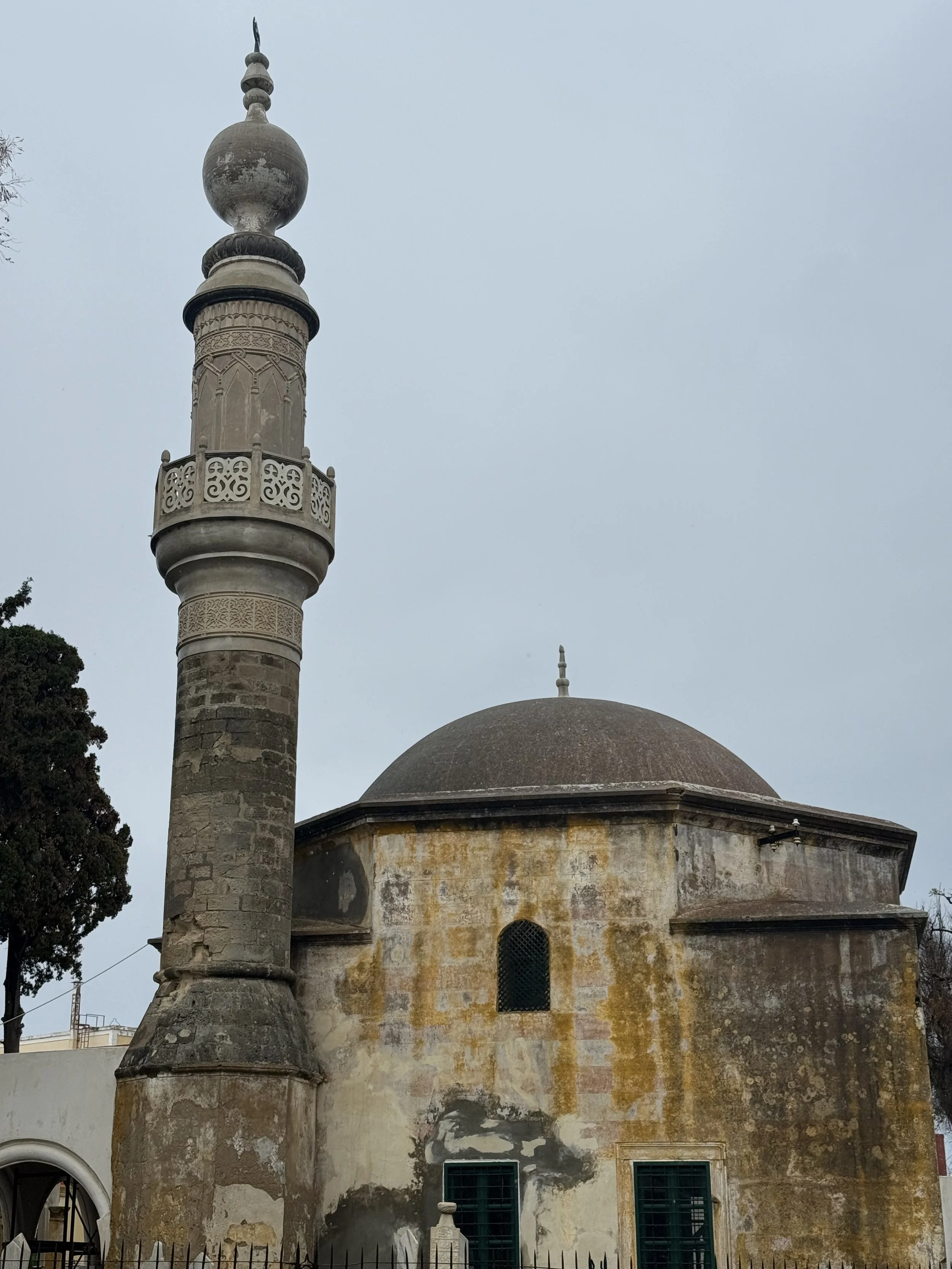
It began with the minarets.
Not the sea, though the island is ringed by it. Not the honeymoon light, the medieval walls, the glossy seduction of the Aegean sold in shimmering fragments to northern Europe. My eye went first to the minarets — those Ottoman uprisings against the sky, domed and slender, weathered and watchful, carrying a grammar I know in my body before I know it in thought. In a land that was not mine, they arrived as kin. Something familiar amid the theatre of elsewhere. Something eastern, surviving.
People come to Rhodes now for beach life, for resorts, for leisure. They come to lie flat beneath the western sun, to drink, to spend, to forget. The island has been packaged with all the usual vocabulary of pleasure: sea-view rooms, infinity pools, old-town charm, curated authenticity, the lightness of temporary escape. This is what late capitalism does best. It teaches us to skim the surface of a place until history becomes décor. Stone becomes backdrop. The dead become ambience.
But Rhodes would not let me skim.
Behind the commerce of pleasure, another island kept glimmering through: Ottoman graveyards, neglected inscriptions, closed mosques, fountains carrying Bismillah, the Muslim library of Hafiz Ahmet Ağa still holding its name against the stone. Another tale lived here — not dominant, not loudly claimed, but insistent. A tale of Ottoman Muslims who left behind not merely buildings, but atmosphere. A civilisation of script, devotion, endowment, memory. An eastern order of feeling.
And that, perhaps, is what moved me most: not grandeur, but residue.
There is something almost unbearable about seeing Arabic script in a state of neglect. I do not encounter it as ornament. I encounter it as pulse. As inheritance. As a language that has passed not only through books and stone, but through blood. When I saw Bismillah inscribed on a fountain wall, it did something immediate to me. It was as if the word rose up from somewhere older than conscious thought. A comforting blanket, yes. But also, a recognition. A sign that amidst ruin, vulgarity, war, tourism, and historical rearrangement, there remains the King of Kings. The one who outlasts all empire. The one whose name survives even when the people who carved it have long been made peripheral.
Faith is in my bloodline, even when discipline is not.
I do not open the Qur’an as regularly as I should. I drift. I fail. I get distracted by noise, by speed, by the minor humiliations of modern life. But I cannot say I am unguided. Guidance comes to me strangely, sometimes embarrassingly, through form, through texture, through beauty, through a carved word on stone in a place I had not expected to be moved. In Rhodes, faith did not come to me as doctrine. It came as shimmer. It danced on plaster, on marble, on old walls, on neglected emblems of a Muslim world that has not vanished, only been pushed to the edge of the tourist frame.
And then there was Mustafa.
I met him at the Ali Pasha mosque — an Afghan migrant, carrying the kind of weariness that Europe knows how to produce. We spoke in Urdu, that intimate bridge language of Persian, Hindustani, and Arabic inheritances. To speak Urdu there, on Rhodes, amid Ottoman remains and Greek stone, was to feel history folding in on itself. It reminded me that language migrates more gracefully than borders do.
Mustafa told me his story. He spoke, and in his voice I heard the entire architecture of Muslim survival in this century: waiting, bureaucracy, exile, humiliation, dignity held together by threadbare effort. And yet there we were, in shared speech, in recognisable cadence, in the ease of mutual understanding. For a moment the world softened. Two Muslim men, meeting in the afterlife of empire, joined not by nation but by recognition.
I think now that perhaps this is what remains when history has done its worst. Not the fantasy of return. Not the illusion of purity. But encounter. Gesture. Fragments of a shared east.
The east is a dangerous word, I know. It has been fetishised, romanticised, plundered, disciplined. But I am not interested in it as fantasy. I am interested in it as moral atmosphere. As a way of sensing the world that has not yet been fully flattened by the west’s obsession with mastery, extraction, and speed.
That flattening is everywhere in Rhodes. On one side: bars, resorts, beach clubs, leisure circuits, the polished machinery of seasonal pleasure. On the other: Ottoman tombstones standing upright in grass, a Muslim library charter recording obligations to the poor, to dervishes, to captives, to sacred recitation, to remembrance. What a brutal contrast. An older world, however imperfect, in which wealth was tethered to service, duty, and piety; and a present in which islands are lit up for consumption.
And then I went looking for Murad Reis.
I found the mosque closed.
That word — closed — is too clean for what I felt. It sounds administrative, almost neutral. But there was nothing neutral about standing before a shut mosque after following minarets like they were stars. I was able to go in, though not really enter. I could only move around the edges, glance around the dervish lodge, and stand among the Ottoman tombs in their deep sleep.
Deep sleep: that is what the graveyard felt like.
Not death as spectacle. Not death as horror. But sleep held by God.
The tombstones rose pale from the grass like witnesses who had outlived the order that once named them. Some were elegant, some worn into near-abstraction, some still carried that quiet Ottoman dignity that resists complete erasure. Standing among them, I did not feel fear. I felt steadied. And then I felt broken.
Because what shattered me was not only that the mosque was closed. It was the sense that an entire devotional atmosphere had been interrupted. A living Muslim space had been reduced to perimeter, distance, explanation. The dead remained, but the breath of the place had been managed, sealed, historicised. This is often how Muslim presence survives in Europe: not as living relation, but as archive, ruin, museum label, tolerated residue. Something admired only once it no longer makes a claim on the present.
At Murad Reis, history hardened in my throat.
I thought of how easily western societies absorb the material beauty of Islamic civilisation while disavowing its moral and spiritual worlds. They will preserve the stone, perhaps, but not the tenderness. They will point to heritage, but not to prayer. They will market old-town magic while forgetting who once gave these walls their devotional pulse. The result is a peculiar kind of violence: not outright destruction, but the slow neutralisation of memory.
And still, the graveyard refused that neutralisation.
Those tombs did not feel like relics to me. They felt like sleepers. Men entrusted to Allah, lying beneath cypress and weather, beyond the indignity of politics, beyond the vocabulary of restoration and tourism. Their silence said more than the island’s advertisements ever could.
Rhodes pierced me because it revealed two worlds sitting almost obscenely close together. One world asks: where will you stay, what will you drink, which beach will you choose? The other asks: what have you forgotten, whose traces do you step over, what forms of devotion have been pushed to the margin so that pleasure may remain uninterrupted?
I do not say this to condemn pleasure. Rest is not the enemy. Beauty is not the enemy. But capitalism is expert at hollowing a place into surface. It asks us to consume without reverence. To admire without accountability. To holiday where others once prayed, studied, fed the poor, buried their dead, and built institutions rooted in care.
What I found in Rhodes was not nostalgia for empire. It was something far more intimate and dangerous: affinity.
A Muslimness older than performance.
A spiritual inheritance not confined by nationality.
A longing for the east not as fantasy, but as ethic.
Because radical love is what we were built for. Not the anaemic love of brochure multiculturalism, but a difficult love — one that reads worn inscriptions, tends neglected graves, listens to migrants in the language that makes them feel less alone, and refuses to let Muslim civilisation be encountered only through fear, security discourse, or sanitised ruin.
I left Rhodes with no revelation, only textures: the coldness of stone, the softness of grass around graves, the visual mercy of Bismillah, the voice of Mustafa in Urdu, the closed ache of Murad Reis, the vertical longing of minarets against a grey sky.
And I left with this thought:
faith does not disappear when neglected.
It waits.
In script.
In stone.
In the deep sleep of Ottoman tombs.
In a closed mosque that still refuses, somehow, to close inside the soul.