
Zafar’s Land خاک
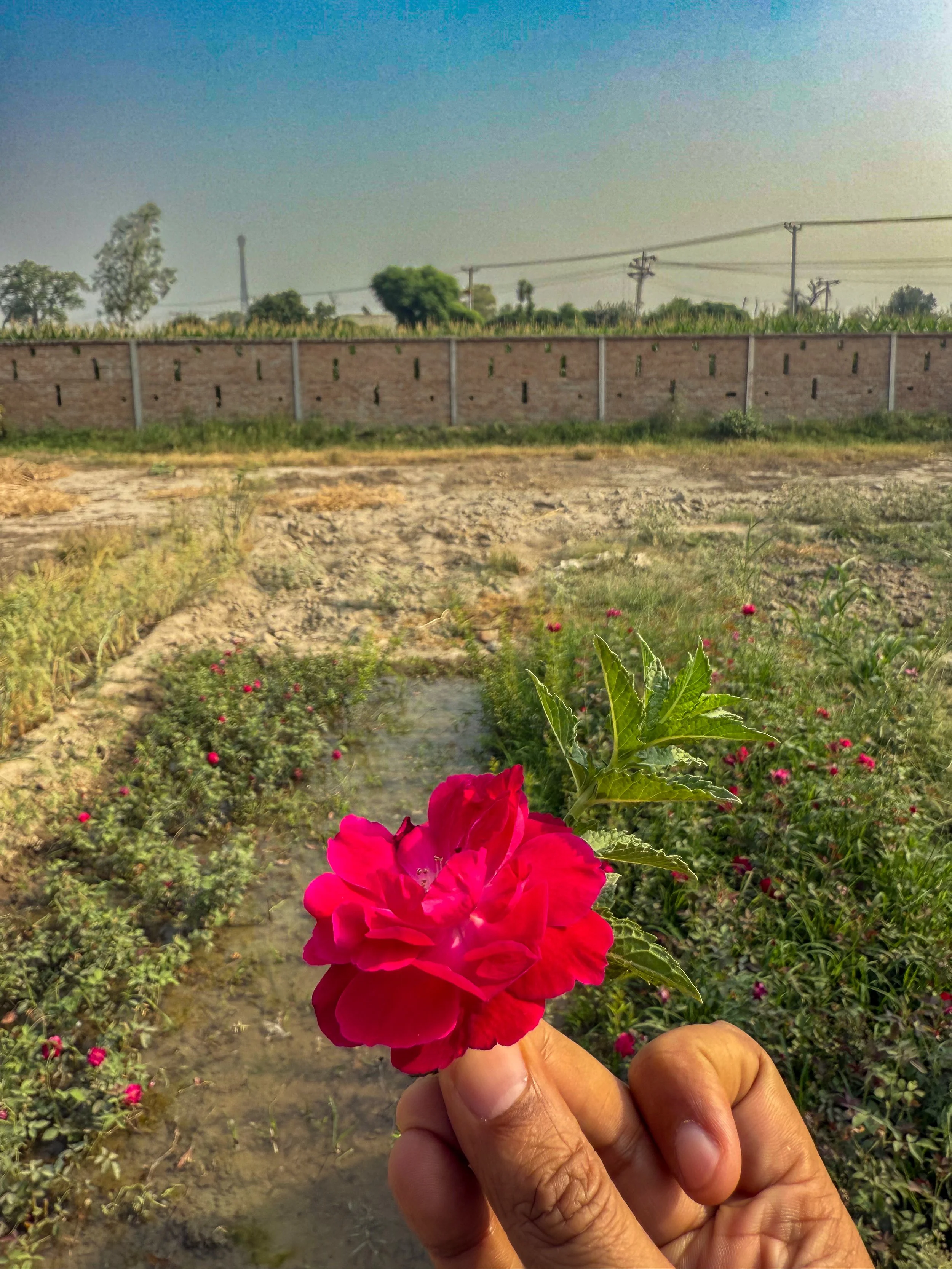
On the road to Pakpattan, the land does not announce itself as inheritance. It arrives first as heat.
Punjab heat is not merely weather. It is a second skin, a force of character, a language older than speech. It presses itself against the car windows and waits for you to admit what you have come to do. Outside, the fields move in long, tired stretches. Wheat, fodder, dust, animals, men on motorbikes, boys in school uniforms, sugarcane carts, the sudden flash of a white shalwar kameez so heavily starched it seems to belong to ceremony rather than labour. The cloth holds itself upright, as if dignity too must be ironed into shape before stepping out into the world.
I was travelling towards my father’s land.
I say “my father’s land,” but even this is not true. Land does not belong easily to anyone. We belong to it for a while, make our claims, bury our dead, draw lines across it, fight over it, register it, inherit it, divide it, sell it. The soil remains. It absorbs our victories and our betrayals with the same dark patience.
My father’s name was Zafar.
Victory.
There is a cruelty in names when life refuses to obey them. My father was a farmer and died as a farmer. He did not become metaphor in his own lifetime. He rose with the land, worked with the land, measured his anxieties through water, weather, crop, price, and season. His body knew the grammar of soil more intimately than mine ever will. He understood what I, with my notebooks and departures, can only circle around: that land is not a romantic idea when it is also debt, labour, honour, quarrel, livelihood, masculinity, hunger, and fatigue.
He is buried in the same soil.
This is the fact that keeps returning to me like a hand on the shoulder. We were not only selling property. We were moving through the afterlife of a man whose body had already been returned to the ground. His name lived in revenue papers; his bones lived in earth. Somewhere between the two, the family had spent years becoming less innocent.
There had been disputes, of course. There are always disputes over inherited land. In Punjab, grief rarely remains pure. It is soon joined by measurement. How many acres. Which share. Which brother. Which signature. Which mutation entry. Which promise made in the courtyard and denied in the office. Which uncle remembers differently. Which cousin arrives with sweetness in his mouth and calculation behind his eyes.
People speak of land as if it is stable, but in families it behaves like fire.
It exposes what was already waiting.
On paper, everything becomes clean. Names align themselves in boxes. Thumbprints darken under official ink. A clerk lifts his eyes and lowers them again. Files are opened, tied, reopened, misplaced, corrected. The government office has its own climate: sweat, dust, stale tea, plastic chairs, men guarding authority through slowness. A fan turns overhead with the defeated rhythm of an old animal. The room smells of paper and exhaustion. Outside, farmers wait with their documents folded into plastic folders, landowners wait, widows wait, brothers wait, men who cannot read wait for men who can, men who can read pretend not to understand until someone pays them to explain.
This too is Punjab: the state as corridor, the citizen as supplicant.
There is something obscene about reducing soil to file numbers while actual soil waits outside under the sun. The land that fed cattle, held rain, received seed, took the weight of my father’s feet, and finally took his body, had to pass through stamped paper to become legible. Without the paper it was memory. With the paper it became saleable.
Perhaps that is what broke something in me.
We drove between Sahiwal and Pakpattan, through a landscape that kept refusing to be ordinary. Somewhere near here lies Harappa, that ancient city of baked brick and buried order, one of the earliest urban dreams of the world. I thought of those who came before us: makers of beads, keepers of grain, potters, traders, mothers, water-carriers, children running through streets now flattened into archaeology. They too must have believed their arrangements would last. Their walls, their seals, their granaries, their drains, their houses. Then the river shifted, or power shifted, or hunger shifted, and the city entered the long silence of soil.
Punjab has always known how to bury civilisation and continue growing wheat above it.
This is what I could not stop thinking: the land is never empty. We arrive late and call it ours.
Pakpattan was once Ajodhan. Later it became the city of Baba Farid, the place of the pure ferry, the saint, the crossing. People still come to that shrine asking for sweetness in a bitter world. They press their faces into thresholds, tie threads, whisper prayers, carry wounds that cannot be shown in daylight. Baba Farid wrote of hunger, humility, dust, longing. His language still moves through Punjab like an underground river.
And yet, outside the car window, another world waited.
A world of property dealers, petrol pumps, court stamps, mobile phone calls, impatient cousins, tired farmers, land reduced to rate per acre. The saint was nearby, but the air was full of transaction. The shrine promised surrender; the office demanded proof. Baba Farid spoke of becoming dust before the Beloved, while we sat in cars calculating the price of dust.
I do not say this to accuse others. I was there too. I had come to sign.
This is the shame of it. I cannot stand outside the story and call everyone else greedy. The quiet betrayal had my own hands in it. I had travelled through the heat not to cultivate, not to repair a boundary wall, not to sit with a farmer and discuss the crop, but to participate in the final conversion: from father to file, from field to money, from inheritance to closure.
Was I betraying him?
Or was I freeing myself from an inheritance I did not know how to carry?
I do not know.
Truth is rarely noble when it arrives. It comes sweating, irritated, hungry, afraid of being cheated. It sits in offices. It signs where it is told. It keeps checking the figures. It remembers old insults at the exact moment it wants to be generous. It loves the dead and resents what they have left behind. It says “Aboo” under its breath and then asks, “How much will be deducted?”
My father, Zafar, spent his life in relationship with land as matter. I inherited land as question.
For him, soil was not aesthetic. It was work. It lodged under nails, entered the lungs, stained the hem, cracked the heel, determined the mood of the house. If the crop was good, the house breathed differently. If water failed, silence entered the rooms before anyone spoke. A farmer does not simply look at clouds; he negotiates with them. He reads the sky like a letter from a difficult relative. He knows that every season is a risk disguised as routine.
And I, his son, have lived much of my life elsewhere — in cities, in airports, in Scotland, in rooms full of books, in museums, in the language of projects and proposals. I have made a life from memory, craft, heritage, the tenderness of endangered things. I have written about wool, rivers, mountains, artisans, disappearing knowledge. Yet here, in Punjab, I found myself facing the most intimate endangered thing of all: the bond between a son and the soil that made his father.
Perhaps I had been preparing for this without knowing it.
All my life I have been drawn to materials that remember touch: wool, cloth, thread, wood, stone. I have believed that objects carry human weather. But land is the first material. Land holds everything and explains nothing. It carries the dead without commentary. It lets us fight above it. It lets brothers become strangers, daughters become claimants, sons become negotiators, fathers become names in documents.
Aboo’s name appeared again and again.
Zafar Iqbal.
There he was, translated into administration. A man who once walked through fields now existed in ink. His name, meaning victory, sat inside a machinery that had no interest in triumph or grief. The system only wanted sequence. Father. Heirs. Shares. Sale. Stamp. Transfer.
I wanted, absurdly, for someone in that office to pause. To understand that this was not a simple matter. That a farmer had died. That his body was in the same earth. That his children were not only dividing land but rearranging memory. That a name like Zafar should not pass through the day unnoticed.
But offices are not built for mourning.
They are built to move grief along.
Outside, the kisan continued his work. Somewhere, a man bent into the field with the intimacy of prayer. Somewhere, a tractor dragged its metal hunger through the soil. Somewhere, a boy carried fodder. Somewhere, a woman washed utensils in a courtyard, listening to the distant argument of men. Somewhere, a buffalo stood under the shade, flicking its tail at flies. Somewhere, the land did what land has always done: accepted everything.
This is what makes soil terrifying. It does not refuse us.
Blood, rain, seed, ash, bones, betrayal, love — it takes all of it.
I thought of Harappa again, buried not far from this landscape. I thought of how archaeologists enter the earth with brushes, searching for fragments of a civilisation that did not know it would one day become evidence. A terracotta figure. A bead. A brick. A seal. A child’s toy. A grain store. The remains of a world that must once have felt permanent.
What will remain of us?
A sale deed. A grave. A few memories of Aboo in the field. The smell of hot dust through the car window. The shame of relief when something complicated is finally over. The knowledge that money can arrive from land, but land does not arrive back from money.
There are betrayals that are loud: shouted, witnessed, unforgivable.
And then there are the quiet betrayals. The ones done politely, legally, in daylight. The ones that come with photocopies, receipts, careful signatures, tea offered in chipped cups. The ones no one can fully condemn because everyone has their reasons. Life moves. Children leave. Land becomes impractical. Farmers die. Families scatter. The old village no longer holds everyone. The city calls. Debt calls. Opportunity calls. Survival calls.
Still, the soil knows.
I do not mean this sentimentally. I do not believe land is pure and humans are corrupt. Land has its own violence. It produces hierarchy, patriarchy, feuds, exclusions, pride. It can trap people as much as it roots them. It can make men cruel with entitlement. It can make women invisible in inheritance. It can turn affection into litigation. To inherit land is to inherit not only belonging but structure. Not only memory but power.
So I wanted the piece to be honest: I loved the idea of Aboo’s land more than I knew the reality of it.
Maybe that is the wound of sons who leave.
We become eloquent about what others labour to maintain.
My father did not need poetry to know the field. His knowledge was not decorative. It was seasonal, physical, exact. He knew where the soil held moisture. He knew which man could be trusted. He knew the cost of seed, the temperament of animals, the politics of water, the meaning of a late monsoon. He knew how land could feed a family and humiliate a man in the same year.
I arrived with grief.
He had lived with responsibility.
There is a difference.
And yet grief has its own claim. I claim the right to mourn what I could not carry. I claim the right to feel broken by a sale that may also be practical. I claim the right to sit in the contradiction: that I wanted release and felt loss; that I mistrusted the disputes and still belonged to them; that I stood near the shrine of a saint and thought not of purity but of paperwork; that my father’s name meant victory and I could not tell who had won.
On the way back, the road seemed both familiar and foreign. Punjab passed by in fragments: a man asleep on a charpoy under a tree, a roadside stall selling tea, children waving at nothing, sacks of grain, election posters fading on walls, the harsh beauty of brick kilns, fields shining with the stubbornness of life. The sun lowered itself but did not soften. Dust rose behind vehicles and settled again, as if the land was forever covering and uncovering its own face.
I wanted to stop the car and take some soil in my hand.
I did not.
Perhaps I was afraid it would feel like evidence.
Perhaps I was afraid it would feel like forgiveness.
Aboo is buried there. Or near there. In that moral geography of Punjab where the dead do not disappear; they become part of the argument. Every time land is mentioned, the dead return. Every time a signature is made, a father stands silently in the room. Every time a field is sold, someone says it had to be done, and someone else, somewhere inside the family, hears it as abandonment.
My father, Zafar, returned to the soil as a farmer.
I returned as a son who had forgotten how to belong to land except through language.
Maybe this is why I write. Not to redeem the sale. Not to make myself innocent. Not to turn family dispute into art and call it healing. I write because the land deserves more than a transaction. Because my father deserves more than a file. Because the soil that held his labour and then his body cannot be allowed to pass silently into someone else’s ownership without at least one witness saying: something happened here.
A life happened here.
A farmer happened here.
A father happened here.
Zafar happened here.
And before him, other men and women whose names I do not know. Before him, saints and rebels and migrants and cultivators. Before him, colonial surveyors measuring Punjab into obedience. Before him, caravans and cattle and river crossings. Before him, Harappa rising in brick and falling into dust. Before him, the old river moving its body through the plain. Before him, seed. Before him, clay.
The land has witnessed everything and kept its own counsel.
Perhaps that is its victory.
Not ours. Not the empire’s. Not the family’s. Not the buyer’s. Not even my father’s, though his name was Zafar.
The victory belongs to the soil because it remains after every claim collapses. It remains after inheritance. After dispute. After grief. After the sons have left. After the daughters have been spoken for or spoken over. After the clerks have closed their registers. After the saint’s devotees have gone home with sugar on their tongues. After the farmer has been lowered into the earth he once worked.
Soil does not console.
It receives.
And maybe that is enough.