
The Border Refused Him دل آویز
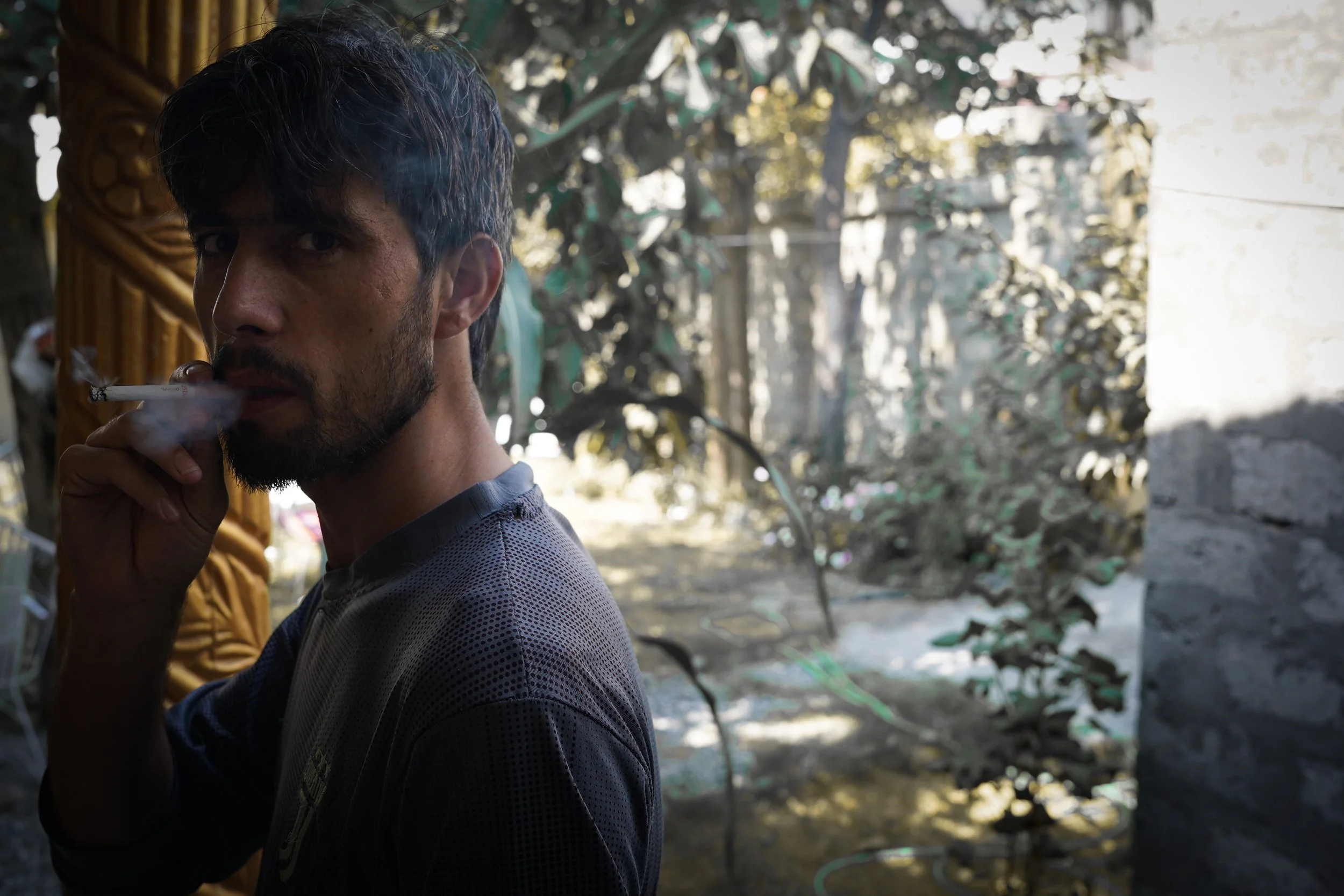
The day has arrived.
It’s not a date on a letter or a stamp on some official notice. It’s a heaviness in my chest when I wake up, the way the air feels wrong in my own house. The way my hands shake when I try to make chai and spill tea leaves across the kitchen counter.
Today, it hits me: my friend, my brother, my caretaker – the man who is not my kin, but could be – is being deported to Afghanistan.
Zakaria is leaving.
For months I told myself a softer story, something I could live with. “This won’t go through,” I said in my head, like a prayer I didn’t dare name as such. “Pakistan can’t be that brutal. They’ll come to their senses. There will be an exception, a loophole, a miracle.” I clung to that illusion the way you cling to the last warmth of a dying fire.
Then one day he came to me, eyes tired, movements small, and said quietly that his family had been given the final notice: they have to go “back” to their “home country.”
Back.
Home.
Two words that cut like knives when you’ve never belonged to the place you’re being sent to.
Zakaria was born in Chitral. He grew up in these mountains, in this valley, under this sky. His childhood was here: dust on his bare feet, the smell of woodsmoke in winter, the chatter of bazaar mornings, Khowar slang shouted across narrow streets. He learned how to walk on these stones, how to sleep under this roof of stars. This is the country that stamped his memories, that shaped his laughter, his fears, his accent.
And yet, on some paper in some office, he is nothing but “Afghan.”
A foreigner in the only home his body remembers.
Why should he move?
When I think of Zakaria, I don’t think of borders or documents. I think of the sound of the front gate creaking open, and how I always knew when it was him. His footsteps carried a particular rhythm, a small drag on the left foot, a quick shuffle when he was in a hurry. I could tell it was Zakaria before I ever saw his face. That’s how close you have to be to someone to recognise them from the way they enter your silence.
We would eat together, plates of daal and roti between us, sometimes sharing from the same dish like brothers raised in the same household. We laughed until our eyes watered. We fought like boys, throwing cushions and teasing each other about our bad habits. I would nag him about smoking when he was stressed, snatching the cigarette from his fingers, threatening to throw the entire pack away.
We have exchanged clothes, too, the way families do without thinking. He has borrowed my sunglasses and my favourite blue cap, wrapped himself in my scarves on cold mornings. Somewhere along the way, “borrowing” became “keep it, it suits you,” and those things stayed with him. His body carrying pieces of my wardrobe through the streets of Chitral, as if we were quietly stitching our lives together in cotton and wool.
“Put sunscreen on,” I’d scold him, standing in the doorway, cream in hand.
He’d roll his eyes, complain like a teenager, then rub it on his face anyway. I wanted to protect his young skin from the high-altitude sun, as if SPF could guard him from everything else that was coming.
We drank sulemani chai together, that thin, healing tea that somehow washes the dust off a day. In winter, the cup would be so hot we’d cradle it with both hands, blowing into the steam, pausing between sips to talk about everything and nothing: gossip from the bazaar, rumours about marriages, village politics, who said what to whom.
We were both outsiders in our own ways, so we would gossip about Chitrali people as if we were a secret committee observing the world with love and mischief. He became my ally, my comrade, my co-conspirator in the quiet rebellion of making a home in a place that didn’t fully claim either of us.
Zakaria has been more than “caretaker.” That word is too small, like trying to fit an ocean into a glass.
He has been my teacher in kindness. In moments when I was hard on myself, he was soft. When I spiralled into self-doubt, he would steady me with a sentence, a look, a simple “Inshallah, it will be okay,” said with more faith than I could find in my own chest.
He humbled me without ever humiliating me. He encouraged me when work felt overwhelming, when the weight of projects and expectations pressed down on my shoulders. He prayed for me – not only in front of me but quietly, in his own time, when I wasn’t looking. I know this because blessings kept arriving like unexpected guests, and I recognise Zakaria’s fingerprints on them.
I have told him secrets I haven’t told my own blood. Things that pressed against my ribs, sharp and shame-shaped. He listened without flinching. No judgement. No sermon. Just his presence, solid and gentle, like a tree you can lean on.
At night, when I returned from my evening walk, I could smell him in the room: the faint scent of soap, tobacco, dust, and something warm I can only call home. Between us there was often comfortable silence – the kind you don’t get with everyone. The silence of two people who respect each other, who don’t need to fill every gap with noise because the bond itself is sound enough.
I know he respected me. I respected him. We held each other carefully, like two people who understand exactly how fragile the other person’s world is.
He was protective of me.
If I was late coming home, my phone would light up with calls.
“Where are you?” he’d ask, voice lined with worry. “Are you okay? When are you coming back?”
It reminded me of a mother waiting for her child, checking the street, listening for footsteps. He would scold me – “Don’t walk alone so late,” “Don’t forget your jacket, it’s cold” – and underneath the scolding there was love.
He was like a father when he told me off for my carelessness, for not resting enough, for skipping meals. Like a mother when I fell ill, sitting beside my bed with a bowl of cold water and a strip of cloth, gently pressing the wet fabric to my forehead to bring my fever down, changing it when it warmed.
He was like a brother when he’d shyly ask for extra pocket money, eyes half-embarrassed, half-hopeful. I would laugh and hand him the cash, pretending to complain, both of us knowing I’d always say yes.
He was everything, and all the in-betweens. A constellation of roles in one person: friend, brother, son, father, nurse, guardian, clown, confidant. How do you distill all of that into a form marked “alien” or “refugee” or “illegal”? How do you stamp “deported” on a man whose hands have cleaned your house, held your secrets, and wiped your brow?
A few months ago, I was sitting in a chai khana in Istanbul, a city that itself is a bruise of histories and borders. I ordered Turkish tea – strong, amber, served in those small curved glasses that catch the light. When I lifted the glass, the smell took me back: straight into our winter evenings in Chitral, Zakaria and I huddled over cups of sulemani chai, hands wrapped around the warmth, our words floating like steam in the cold air.
I thought of him with every sip.
The world is vast, yet sometimes it feels like all my roads circle back to that small kitchen, that battered kettle, those quiet shared moments.
But this isn’t about me and my nostalgia, my loneliness at foreign tables. This is about Zakaria’s future, and what that word even means under the Taliban.
What does “future” look like for a young, sensitive, soft-hearted man under a regime that fears softness? Where is there room for the gentle way he moves, the tenderness in him, the capacity for care? What happens to his laughter in a place where joy itself feels suspicious?
There is no space for his sensitivity in that system. No space for his kind of light. I am terrified for him. It is a fear that sits low in my stomach, physical, constant, like a stone.
When I think of the state that is sending him away, I feel a kind of betrayal that doesn’t have enough words around it yet. For a country to raise a child on its soil, to use his labour, to rely on his quiet, invisible work, and then one day tell him he must “go back” to a place that has never held him – what is that, if not abandonment on a national scale?
He belongs here. His memories say so. His muscles say so. The dust on his shoes says so.
But paper says otherwise.
And paper wins.
I don’t know how to write an ending to this. There is no neat conclusion, no moral that makes this pain sit tidily on the page.
All I know is this: love has never obeyed borders.
Love has never respected visa regimes or deportation orders or national categories. Love sits in the way we pass each other cups of chai. In the way we know each other’s footsteps on the gravel. In the way a man born in one country can still feel like your brother even if the law insists he is something else.
Zakaria may be forced to cross a line on a map, but nothing can deport him from my life. No uniform can evict him from my memories. No government can unteach me the kindness he practiced daily, the patience he lived, the softness he held in a world that keeps trying to harden us.
He is leaving, yes. They are taking him away from the mountains he knows, from the house whose gate he opens like it’s his own. But they cannot take away what he has already planted in me.
Because in the end, love is not possession. Love is not a border post.
Love is freedom.
And in my heart, he will never be deported.